
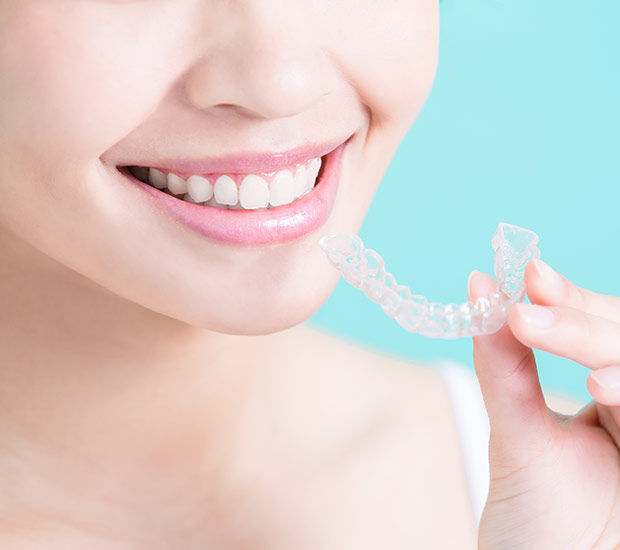
Clear braces are an innovation in dental technology that has given patients a way to straighten teeth less visibly than traditional metal braces. Like metal braces, clear braces can treat misaligned teeth and improve oral health. Clear braces are a type of braces with brackets and wires made of clear or less visible ceramic material.
People with misaligned and crowded teeth can achieve straighter bites and smiles subtly with clear braces. Our team at Oak Tree Dental in Poway and the surrounding area can help. Call us today at (858) 748-2101 to schedule an appointment or learn more about our services.
How clear braces work
Clear braces consist of plastic or ceramic brackets glued to each tooth. A wire made from metal or a white material connects the brackets. Over time, the wire pulls the teeth in different directions to straighten them. Researchers in dentistry explain that this movement occurs because of the bone tissue rebuilding process.
Clear braces take around 12 to 36 months to straighten teeth. Clear braces may take longer than metal braces to work because they consist of more fragile materials. The brackets on clear braces are replaced often to prevent breakage from pressure as teeth move. Low-quality ceramic braces can cause the brackets to break, resulting in an extended treatment time.
“Clear braces consist of plastic or ceramic brackets glued to each tooth.”
Candidates for clear braces
Clear braces are a good option for those who want to wear braces without feeling self-conscious. Candidates should have all their adult teeth and have stopped growing, as ceramic braces can break if there is too much movement. This recommendation means most teenagers and adults are eligible for this type of alignment.
Children are often not good candidates for clear braces, as their mouths are still developing. Those who have more complex issues of the teeth, bite, and mouth should look into a more traditional option. Ceramic is less durable than metal, so those involved in extracurricular activities that involve a lot of mouth movement or contact sports may want to consider more durable metal braces.
“Clear braces are a good option for those who want to wear braces without feeling self-conscious.”
Benefits and drawbacks of clear braces
There are benefits and drawbacks to clear braces that candidates should consider. Clear braces provide cosmetic benefits as they are less noticeable on teeth than traditional metal braces. They are less visible because the ceramic material is either tooth-colored or clear. Clear braces work faster than clear aligners, which can take one year or longer to straighten teeth.
Although clear braces are less conspicuous, the material used is more fragile than traditional metal braces. This fragility means a bracket may crack during the process and need replacement. A 2016 study found that clear braces are more than twice as likely to break than metal braces. Another potential drawback is that clear bracket ties can stain easily. Patients should avoid this by brushing and flossing after every meal, avoiding foods and drinks that cause discoloration, and not smoking or using whitening toothpaste.
“There are benefits and drawbacks to clear braces that candidates should consider.”
Check out what others are saying about our dental services on Google: Clear Braces in Poway, CA
 Check out what others are saying about our dental services on Google:
 What to expect during clear braces treatment
The length of clear braces treatment will vary for each patient depending on their malocclusions. Typically, patients with clear braces will undergo treatment for about a year and a half to three years. Clear braces treatment may take longer than metal braces due to their less durable material.
As the patient's teeth move, the ceramic brackets may need replacing to prevent breakage from pressure. This replacement results in a slower adjustment time and a longer straightening process since broken brackets can cause additional treatment delays. A 2016 study found that clear braces are more than twice as likely to break as traditional metal braces.
“Typically, patients with clear braces will undergo treatment for about a year and a half to three years.”
Questions answered on this page
Q. Who is a good candidate for clear braces?
Q. What are the benefits and drawbacks of clear braces?
Q. What is the difference between clear braces and clear aligners?
Q. How long does clear braces treatment take?
People also ask
Q. What are some cosmetic dentistry treatment options?
Q. What restorative methods can help patients improve their smiles?
Q. How should people take care of their teeth after a smile makeover?
Difference between clear braces and clear aligners
One of the major differences between clear braces and clear aligner trays, such as Invisalign, is the material and texture. While clear aligners provide a smooth, plastic design, clear braces provide the durability that comes with traditional braces. This allows clear braces to be both sturdy and discreet without the fragility and wear-and-tear of plastic.
Another difference between clear braces and aligners is their treatment time. Clear braces may require a slight increase in treatment time compared to traditional metal braces, but they typically require less than clear aligners because of the constant force being applied on the teeth. Lastly, clear braces cannot be removed for eating and drinking as clear aligners can, making it more difficult to keep up oral hygiene. However, patients undergoing clear braces treatment are given detailed instructions on care and maintenance practices for both the braces and teeth themselves.
“While clear aligners provide a smooth, plastic design, clear braces provide the durability that comes with traditional braces.”
Frequently asked questions
Yes, patients should modify their diets while wearing braces of any sort to avoid damage. Patients should avoid hard, sticky, crunchy, and chewy foods, as these are likely to break brackets. Limiting drinks and foods that can stain and discolor is also recommended.
Patients who play sports or engage in other physical activities during treatment should take necessary precautions to prevent potential damage. Patients should wear a mouthguard to protect the braces while playing sports. The mouthguard will prevent any impact from damaging the braces or hurting the inside of the mouth.
Most patients receive retainers after treatment is completed. Retainers are worn at night to help keep the teeth in alignment. It is also important to continue good dental hygiene to protect the teeth.
There may be some discomfort during treatment as braces cause the teeth to move. This discomfort is most apparent when the patient first gets them and following wire tightening. However, clear braces' ceramic material is less abrasive to the gums and sides of the mouth than traditional metal braces.
No, clear braces are not completely invisible. Even the most subtle orthodontic treatments may be noticeable if someone is looking closely. However, they are distinctly less noticeable than traditional metal braces.
Invisalign® terminology
With Invisalign® treatment, the patient will receive a series of aligner trays and swap out each one for the next one in the series every two weeks in order to gradually straighten the teeth.
The blue compliance indicator is a small blue dot on the aligners that will fade from blue to clear in order to indicate if the patient is wearing the aligner for the proper amount of time and where the patient is in the Invisalign® process.
ClinCheck® software allows professionals to map out the straightening process the patient’s teeth will go through with Invisalign® in great detail.
The gum line is the line in the mouth where the teeth and gums meet. If a patient struggles with gum recession, then the gum tissue around the teeth may begin to wear away.
Incisal ridges are the portion of the crown of the tooth that makes up the incisal portion and can be a direct cause of overbite if they are extended too far.
An iTero Element® scanner allows professionals to create a 3D image of the patient’s teeth in minutes and predict what it will take to move the teeth into proper alignment.
Malocclusion is the condition in which the upper and lower teeth do not meet properly when the bite is closed. Conditions of malocclusion can include overbite, underbite, crossbite and open bite; all of which are treatable with Invisalign®.
An overbite is a type of malocclusion that occurs when the upper teeth jut out over the lower teeth, covering them and causing other issues.
Polyurethane Resin is a USP Class VI medical grade, high molecular weight compound that makes up the Invisalign® aligners.
SmartForce attachments are small attachments that professionals place on the patient’s teeth before placing aligners to help move the teeth.
Smart Track® material is in Invisalign® aligners to increase comfort, improve control of movement, increases the speed of treatment and applies a gentle force to the teeth over time.
Call us today
Clear braces are a great way to achieve a beautiful smile without feeling self-conscious about visible braces. Contact Oak Tree Dental at 858-748-2101 and learn more about clear braces and whether it is the right tooth straightening option for you.
Individual results vary. How long a treatment lasts, and how it looks and feels, depends on each patient.