
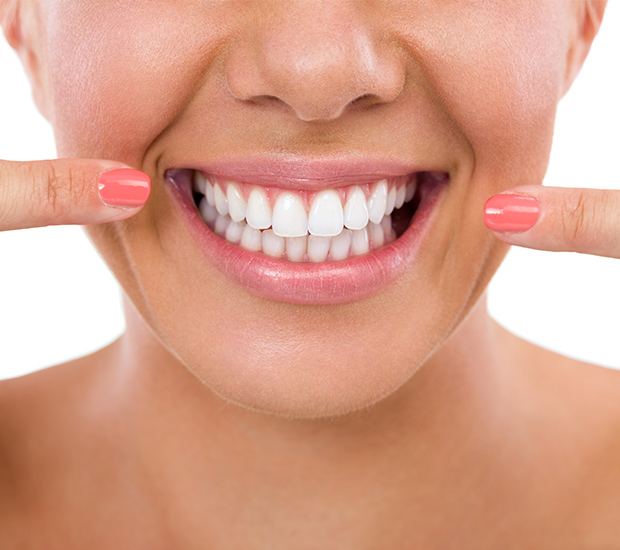
People who are embarrassed about their smile may want to consider gum contouring to improve the symmetry and balance of their smile. The term is synonymous with gum reshaping, and the terms can be used interchangeably. Gum contouring, or reshaping, is a cosmetic procedure that evens out the gum line and may also offer medical benefits.
Gum reshaping is available at Oak Tree Dental in Poway and the surrounding area. People who are looking for a simple and effective way of improving their smile may want to consider gum contouring. We can discuss the procedure and help determine if it is a good choice. Call us at (858) 748-2101 to schedule an appointment.
Reasons for gum reshaping
Most people probably do not think about their gums often except when they floss or are at the dentist's office. However, for some people, gum tissue can be a real concern. It may be uneven, which causes the smile to look asymmetrical.
The gum tissue may be too high, which makes the teeth look longer than normal. The tissue may also be too low, which makes the teeth look small. According to the National Library of Medicine, the latter effect is known as a gummy smile, and it occurs when the gum line drops 4 mm or more.
“Most people probably do not think about their gums often except when they floss or are at the dentist’s office.”
Benefits of gum contouring
Gum reshaping offers both cosmetic and medical benefits. Uneven gums should be examined by a dental professional to determine if they pose a medical problem or just a cosmetic issue. Regardless of why patients seek gum contouring, they may receive the following benefits after undergoing the procedure.
- Restoration of gum health: One of the causes of excess oral tissue is various types of diseases. Gum reshaping allows dentists to remove infection during the process, enabling gums to heal and become pink and healthy again once the restoration process is complete.
- Improvement of cosmetic appearance: Uneven gums look unsightly. Some patients may feel like too much of their gums show when they smile, while others may believe a receding gum line looks unattractive. Gum contouring evens out the gum line to enhance a patient’s smile.
- Reduced risk of losing teeth: Receding gums do not supply a good anchor for teeth. They may even expose teeth roots if they are not cared for quickly. If there is not enough healthy tissue to secure teeth, they are more likely to fall out if any trauma occurs. Reshaping gums is an effective solution for anchoring teeth in place and restoring overall oral health.
“Reshaping gums is an effective solution for anchoring teeth in place and restoring overall oral health.”
The procedure
The process of gum contouring typically takes only one office visit. A local anesthetic is applied to numb the area, which makes the procedure virtually painless. Two methods, a scalpel or laser, may be used to remove excess tissue and reshape the line of the gums. In many situations, the dentist will also remove a small bone piece at the root of each tooth.
Both the scalpel and laser methods are relatively quick, although the laser is a bit faster. Using a laser also seals the wound during the procedure, which makes for quick healing, minimal bleeding, and no stitches. The change cannot be undone, because removed gum tissue does not grow back.
“The process of gum contouring typically takes only one office visit.”
Check out what others are saying about our dental services on Google: What Is Gum Contouring and Reshaping in Poway, CA
 Check out what others are saying about our dental services on Google:
 The recovery process for gum reshaping
Though gum reshaping requires little downtime, it may take days or weeks for patients to heal completely. However, recovery time depends on the extent of the surgery. Patients may have to limit their activities for one or two days, depending on how they feel and any tenderness they have. We will provide specific post-surgery dietary instructions to the patients.
In most cases, patients will usually have a follow-up appointment anywhere from a few days to a week after the procedure to monitor healing. This is also a chance for the patient to bring up any questions or concerns they have about maintaining their oral health and new smile.
“Though gum reshaping requires little downtime, it may take days or weeks for patients to heal completely.”
Questions answered on this page
Q. Why would someone get gum reshaping?
Q. What happens during the procedure?
Q. What are the benefits of gum contouring?
Q. How long does it take to recover from gum surgery?
People also ask
Q. How can I cope with dental anxiety?
Q. What are the signs of gum disease?
Q. What are some common signs of receding gums?
Q. What are the keys to understanding root scaling and planing?
Frequently asked questions
Most patients feel no pain during the reshaping procedure because most dentists use a local anesthetic to numb their mouths. However, many patients experience minor discomfort for several days after the operation. Over-the-counter medications such as Aleve®, Motrin®, Advil®, and Tylenol® should relieve any soreness.
Patients should contact their insurance providers to determine the cost of this procedure. Not all insurance companies will cover it if it is only for cosmetic purposes. Some plans may cover the cost only if the treatment is medically necessary.
There are few risks associated with gum contouring. Some patients may develop infections that can easily be cured with antibiotics. Others may have an allergic reaction to the anesthesia, but this is extremely rare.
Anyone unsatisfied with the appearance of their gum line is a candidate for this procedure. The American Academy of Periodontology states that this treatment can be particularly beneficial for patients whose gum lines have shifted due to tooth loss. Because this procedure also has medical benefits, it is an effective solution for patients with periodontal disease.
Dentists use a pen to mark the desired gumline. Next, they use either a scalpel or a laser to remove excess tissue. Then, grafted gums are stitched together so the healing process can begin.
Gum disease terminology
Chronic periodontitis is the most common form of periodontitis, involving inflammation of the tissue surrounding the teeth and pockets forming as well.
Necrotizing periodontal disease is an infection that causes lesions to form on the face and other symptoms due to the necrosis of gingival tissues, periodontal ligaments and alveolar bone.
A periapical cyst is a pathological cavity, roots of the teeth, that typically has epithelium in the lining and contains fluid or soft matter.
Periodontal disease is a serious inflammation of the gingival tissues and the periodontal membrane of the teeth that causes pain and helps form deeper gingival sulcus.
Periodontal ligaments are a group of tissue fibers that help attach the tooth to the alveolar bone, which can sustain damage from gum disease or improper oral hygiene.
A periodontal pocket is a potential area of space, known as a gingival sulcus, which is deeper than normal and can contain bacteria that cause an infection.
Periodontal surgery is the treatment of extreme levels of periodontal disease that can involve multiple techniques to remove the inflamed tissue and infection before it spreads.
Learn more about gum contouring
If you are wondering if you are a good candidate for gum reshaping, we can help. We will evaluate your gums and teeth, discuss your personal goals, and go over the most effective options. For additional questions about gum contouring, give our office a call at 858-748-2101.
Individual results vary. How long a treatment lasts, and how it looks and feels, depends on each patient.